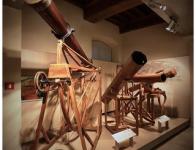
Acoustic telescopes are specialized devices designed to collect, focus or amplify sound from distant or faint sources. Unlike optical telescopes, which collect light, acoustic instruments use structures such as horns, reflectors or carefully shaped surfaces to concentrate sound waves. Some historical designs were used to investigate sound propagation or to listen for distant acoustic signals.
Early acoustic focusing devices...
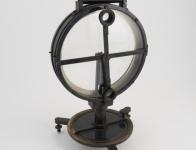
A magnetic inclination instrument, often called a dip circle, was designed to measure the angle between Earth's magnetic field and the horizontal plane. Unlike ordinary compasses, which primarily indicate direction, these instruments allow a magnetic needle to rotate vertically. The needle aligns with the magnetic field, enabling researchers to measure the angle of magnetic inclination at different locations.
Dip circles we...
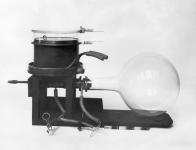
The spinthariscope is a small scientific instrument that allows users to observe tiny flashes of light caused by radioactive particles. Inside the device, radioactive material produces particles that strike a phosphorescent screen, creating brief flashes visible through an eyepiece. In dark conditions, observers can see individual flashes appearing almost like tiny sparks.
Invented by William Crookes in the early twentieth ...
The Michelson interferometer is a precision optical instrument that splits a beam of light into two paths and then recombines them to create interference patterns. By carefully adjusting the optical components, scientists can observe changes in the resulting pattern and measure extremely small differences in distance or optical properties. The instrument is capable of detecting changes far smaller than ordinary mechanical meas...
The Nottometer was a specialized meteorological instrument associated with the investigation of atmospheric conditions and temperature-related effects. Instruments of this type were developed during periods when scientists were experimenting with different ways to measure environmental variables accurately. Their unusual construction reflects the growing importance of precise observation in meteorology and environmental scienc...
The thermoscope was an early instrument used to demonstrate changes in temperature before the development of modern thermometers. Some versions consisted of glass tubes containing air and liquid, with the movement of the liquid indicating changes in the temperature of the surrounding environment. The instrument did not necessarily provide a standardized numerical reading, but it allowed observers to detect relative changes.
...
The Pickering photometer was an astronomical instrument designed to compare the brightness of stars with remarkable precision. Developed in connection with astronomical work at Harvard, the instrument used optical arrangements that allowed astronomers to compare light from celestial objects. Such measurements were essential for building reliable catalogs of stellar brightness.
Photometric instruments helped transform astron...
A heliostat is an optical instrument designed to keep sunlight directed toward a fixed point as the Sun moves across the sky. It uses mirrors and a mechanical tracking system that rotates throughout the day to compensate for the apparent movement of the Sun. This allows sunlight to be redirected into laboratories, telescopes or other scientific apparatus without the beam changing direction.
Heliostats were used in optical e...
The Cavendish apparatus was designed to measure the gravitational attraction between relatively small masses. Using a torsion balance with suspended masses and larger surrounding objects, the experiment demonstrated that gravitational attraction could be measured even between objects located inside a laboratory. Its extraordinary sensitivity allowed researchers to investigate the strength of gravity without relying on astronom...
The Wilson cloud chamber is a scientific instrument that makes the paths of invisible charged particles visible. It works by creating a chamber containing supersaturated vapor, in which tiny droplets form along the paths of particles passing through the chamber. These droplets create visible tracks that researchers can photograph and examine to investigate particle behavior.
Invented by Charles Thomson Rees Wilson in the ea...
The sphygmograph was an early mechanical instrument designed to record a person's pulse automatically. Rather than simply allowing a doctor to feel the heartbeat, the device used a mechanical sensor placed against the wrist to detect pulsations. A system of levers translated these tiny movements into a trace recorded on a moving surface.
Developed during the nineteenth century, the sphygmograph represented an important step...
The kymograph was a mechanical recording instrument designed to transform physiological or physical movement into a visible graph. It typically consisted of a rotating drum covered with paper, onto which a stylus connected to a measuring device recorded movement over time. As the drum rotated, the instrument created continuous traces representing changing measurements such as pressure, muscle contractions or heart activity.
...
The Eötvös torsion balance was a highly sensitive instrument developed to investigate subtle differences in gravitational forces. Hungarian physicist Loránd Eötvös used the apparatus to study whether objects made from different materials responded identically to gravity. The instrument relied on an extremely delicate suspended balance that could detect tiny changes in gravitational force and direction.
The apparatus wa...
The Hicks-Crookes-type torsion radiometer is a peculiar scientific instrument combining a radiometer with a delicate torsion mechanism. Built during the nineteenth century, it used a suspended system inside a glass enclosure to investigate physical effects involving radiation, heat and mechanical movement. Its unusual construction was intended to make small physical effects visible through the movement of delicate components.
...
Kelvin's Harmonic Analyser was an enormous mechanical computing machine designed to break complex curves into their individual mathematical components. Developed by Lord Kelvin in the nineteenth century, the machine used a series of rotating discs, rollers and mechanical linkages to calculate harmonic components from graphical data. Rather than relying on electronic circuits, it performed mathematical operations through carefu...
The Curta calculator is one of the most remarkable mechanical calculating instruments ever created. Designed by Curt Herzstark and introduced in the mid-twentieth century, the device was a compact cylindrical calculator capable of performing arithmetic operations through a complex system of gears, sliders and rotating mechanisms. Despite its small size, the Curta could perform calculations that would otherwise require much lar...
A magnetic dip needle is an instrument used to measure the angle at which Earth's magnetic field intersects the horizontal plane. Unlike a traditional compass, which primarily indicates horizontal magnetic direction, a dip needle is free to move vertically and align itself with the Earth's magnetic field. This allows scientists to study the magnetic inclination at different locations.
Magnetic dip needles were important in ...
The Nipher shield was developed as part of efforts to improve meteorological measurements, particularly those involving precipitation and snow. Its specialized design was intended to reduce the effects of wind and other environmental factors that could interfere with accurate observations. Such instruments illustrate the importance of carefully controlling the surrounding environment when collecting scientific data.
Meteoro...
A galvanometer is an instrument used to detect and measure small electrical currents. Early galvanometers often used a magnetic needle or suspended coil that moved in response to the magnetic field generated by an electrical current. The amount of movement could be measured against a scale, allowing scientists to investigate electrical phenomena with greater precision.
Galvanometers were central to the development of electr...
Optical telegraph demonstration instruments were designed to illustrate how information could be transmitted over long distances using visual signals. Early systems used mechanical arms, shutters or movable elements that could be arranged into different positions representing letters or messages. Observers at distant stations could read these signals and relay them further along a network.
These instruments played an import...
A sextant is a precision optical instrument used to measure the angular distance between celestial objects and the horizon. By observing the Sun, stars or other celestial bodies, navigators can determine their position on the Earth's surface. The instrument uses mirrors and a graduated arc to allow accurate angular measurements, making it essential for navigation long before satellite positioning systems became available.
S...
Barlow's wheel is an early electromagnetic device consisting of a rotating metal wheel positioned between the poles of a magnet. When an electrical current is applied through the wheel and a conductive contact, electromagnetic forces cause the wheel to rotate. The instrument was developed by English mathematician and physicist Peter Barlow in the early nineteenth century.
The device was important in the early investigation ...
A spherometer is a precision instrument used to measure the curvature of spherical surfaces. It typically consists of a central measuring screw surrounded by three fixed legs that rest on the surface being measured. By measuring the height difference between the central screw and the supporting legs, the instrument can be used to calculate the radius of curvature of a surface.
Spherometers were particularly useful in optics...
A nephoscope is a meteorological instrument used to observe the movement of clouds across the sky. Early versions often consisted of a reflective surface or a grid that allowed observers to estimate cloud direction and speed by comparing the movement of cloud reflections or patterns over time. The instrument helped meteorologists gather information about atmospheric motion before modern radar and satellite technology existed.
...
A seismograph is an instrument designed to detect and record movements of the Earth's surface caused by earthquakes and other seismic events. Early mechanical seismographs used suspended masses, mechanical linkages and recording systems to capture ground motion. Because the suspended mass tends to remain relatively stationary while the ground moves beneath it, the instrument can detect vibrations and record their intensity and...